Symptom one: absolutely nothing happens
No light, no sound, no movement, from remote or wall button.
- Power. Check the breaker, and check the opener is plugged in — ceiling outlets get knocked by ladders and storage more often than you would think. If a GFCI outlet feeds it, reset that.
- Lock mode. Many wall consoles have a lock or vacation button that disables the remotes. It is easy to press by accident and the usual sign is a flashing indicator on the wall unit.
- The wall button itself. If the remote works but the wall button does nothing, the button or its wiring has failed, not the opener.
- If there is power and still nothing, it is the logic board or the transformer, and that needs a technician.
Symptom two: the motor runs but the door does not move
This is the one people most often misdiagnose, because two very different faults look identical.
- The trolley is disengaged. Somebody pulled the red release cord. Re-engage it — usually by pulling the cord toward the door or running the opener until the carriage clicks back in.
- A stripped drive gear. On chain and belt units a nylon gear wears against the worm shaft and eventually rounds off. Classic LiftMaster and Chamberlain fault, inexpensive to fix.
- A broken spring. Look at the bar above the door for a gap in the coil. If a spring has gone, the opener is trying to lift the full weight of the door and cannot. This is not an opener fault. Stop using it.
Tell these apart by pulling the release cord with the door closed and lifting by hand. If the door comes up easily and stays put, the springs are fine and the fault is in the opener. If it feels like lifting a fridge, the spring has broken.
Symptom three: the wall button works, the remote does not
- Battery — and in winter especially. A remote left in a cold car delivers much less voltage than it would in July, so it works at the door and fails from the end of the drive. Replace it before anything else.
- Reprogramme the remote to the opener. The learn button is usually under the light cover.
- The aerial. A thin wire hangs from the motor unit and should hang straight down, not be tucked up or coiled. Range problems often trace to this.
- If a new battery, a reprogramme and a hanging aerial all fail, it is the receiver.
Symptom four: it starts to close, then goes back up
The safety system working as intended. In order:
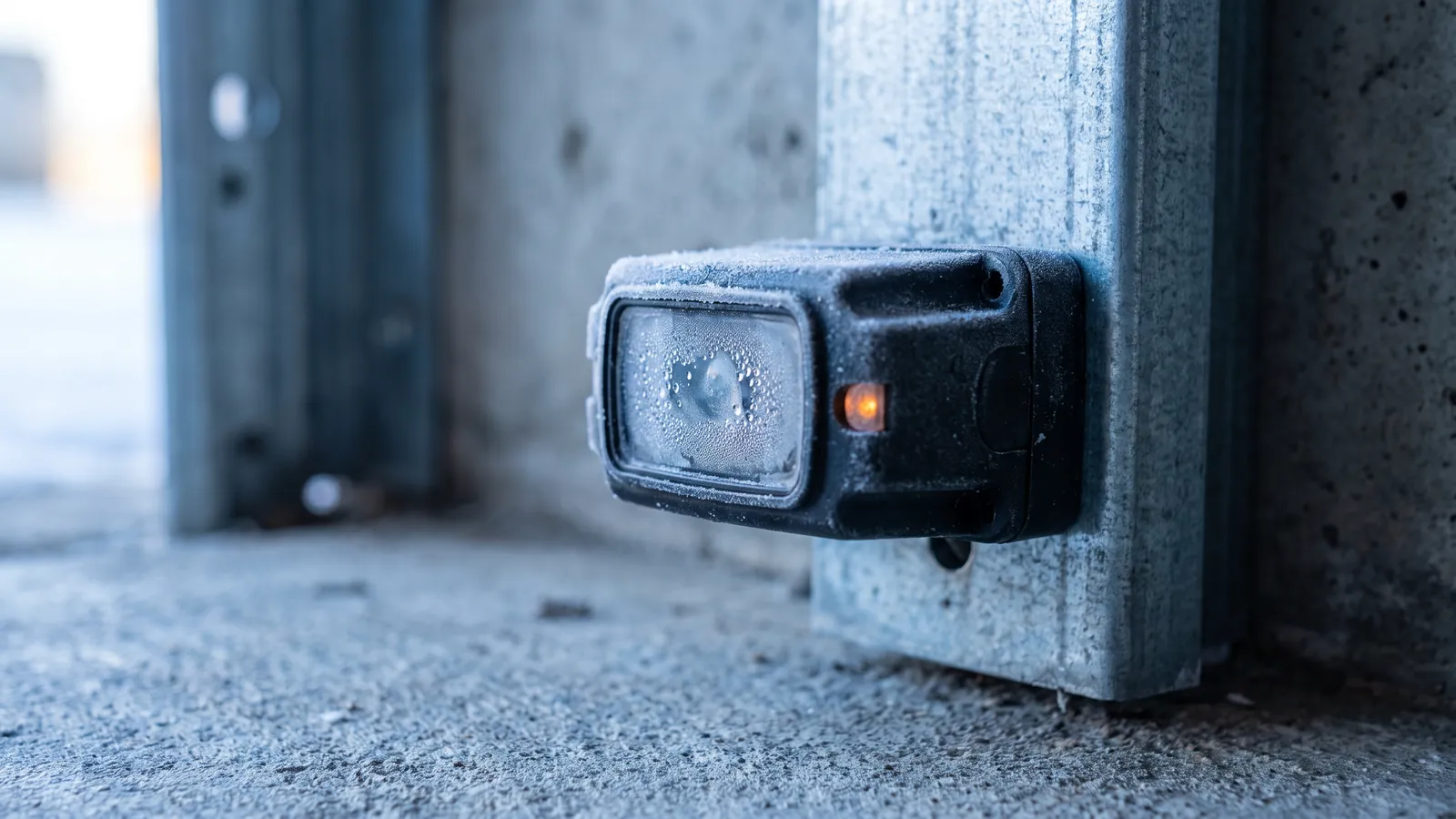
- Clean both photo-eye lenses with a dry cloth. In a cold garage, condensation on a lens is the single most common cause of this, and it explains why the door misbehaves in the morning and is fine by lunchtime.
- Check alignment. Both eyes have indicator lights; a steady light on each means they can see each other. Nudge the dark one until it settles.
- Look for obstructions in the opening, including the bottom seal frozen to the slab, which the opener reads as hitting something.
- If both lights are steady and nothing is in the way, the travel limits or force setting need adjusting, and that is a technician job.
When to stop
Stop immediately if you see a gap in the spring, a loose or frayed cable, or a door hanging crooked. Those are not opener problems, and running the opener again makes each of them worse. Stop also if the door does not reverse when it meets an obstruction — that is the one genuinely dangerous fault on a garage door, and it should not wait.
Common questions
Why does my door only misbehave in the morning?
Condensation on the sensor lenses. A cold garage and a warm car put moisture into the air, and it settles on the coldest surfaces overnight — including photo eyes three inches off the slab. By midday it has evaporated. A dry cloth on both lenses is the whole fix.
The motor runs but nothing moves. Opener or spring?
Pull the release cord with the door closed and lift by hand. A healthy door comes up with modest effort and holds where you leave it — so the fault is in the opener. If it feels impossibly heavy or slams back down, a spring has broken and the opener is innocent. Stop there and call.
My remote works up close but not from the drive.
Battery first, especially in winter — cold drops the voltage a remote can deliver, so range collapses while it still works at arm's length. After that, check the aerial wire hangs straight down from the motor unit rather than being tucked up out of the way.
Is it safe to disconnect the sensors to get the door shut?
No. They have been mandatory since 1993 because of children and pets killed by closing doors, and an opener with them bypassed will close on anything. If you must shut the door before a technician arrives, most openers will close while you hold the wall button down, which keeps you watching the opening the whole time.
How do I test the safety reverse?
Lay a flat length of timber — a two-by-four on its side works — on the floor in the door's path and close the door. It must stop and reverse on contact. If it does not, the force setting is wrong or the mechanism is faulty, and it needs looking at promptly. It is worth doing this once a year.
Related: Opener repair · Safety sensors · LiftMaster and Chamberlain · Winter guide