The cheapest job on the door, and the one you feel every January
A bottom gasket is a strip of rubber worth a few dollars. It is also the only thing between a heated room above the garage and the gap under a steel door — and when it hardens, splits or freezes to the slab, you notice in the heating bill and in the door that will not open.
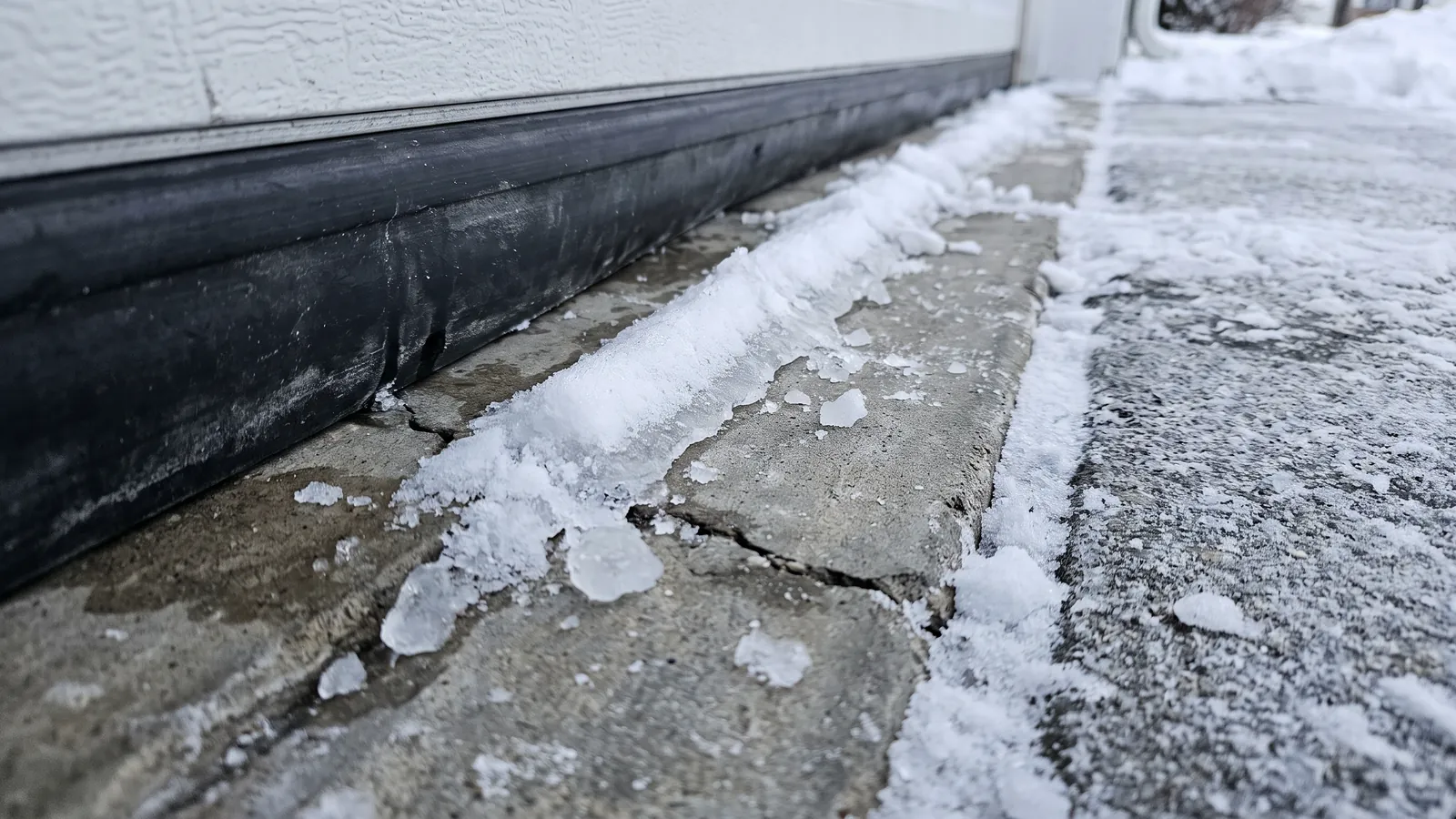
There are four seals on a typical garage door and they fail in different ways. The bottom gasket is a U-shaped or T-shaped rubber strip in a retainer along the bottom edge; it takes all the abrasion, all the meltwater and all the road salt, and it is the one that goes first. The side weatherstripping is the flexible flap nailed to the jambs, which shrinks and cracks with UV and age. The header seal across the top does the same job overhead. And some garages have a threshold seal bonded to the slab itself, which is the answer when the concrete has settled or was never level.
What goes wrong in this climate is specific. Cheap gaskets are made from compounds that stiffen as the temperature drops; at 20 degrees they stop sealing and simply sit there like a plank, and at 20 below they crack. Meltwater runs under a hardened gasket, refreezes overnight and glues the door to the slab — and then the opener tries to lift a door that is bonded down, which tears the gasket, bends the bottom section or strips a gear, turning a forty-dollar part into a real repair. Salt accelerates the whole process, and the same salt is working on the bottom brackets and the cable ends an inch away.
The other half of the problem is the floor. Kansas City has a lot of older garages — the city's median house dates from 1961 — where slabs have settled, cracked or were poured with a dip. A standard gasket cannot bridge an inch of daylight at one corner. That is what a threshold seal is for: a rubber ramp bonded to the concrete that the door closes against, raising the sealing line above the low spot. It also keeps out the water that otherwise runs in off a sloping drive during a thaw.
We fit gaskets in compounds rated to stay flexible well below freezing, which is not what comes on a builder's door. The retainer is checked at the same time, because an aluminium retainer that has been crushed by years of closing onto gravel will not hold a new gasket properly. It is a small job and an inexpensive one, and it is the single best-value thing you can do to an attached garage before winter.
What's included
Cold-rated compounds
Gaskets specified to stay pliable below freezing instead of hardening into a plank when you need them most.
Retainer checked, not ignored
A crushed or corroded bottom retainer will not hold a new seal; it is inspected and replaced where needed.
Thresholds for uneven slabs
Where the concrete has settled or cracked, a bonded threshold seals a gap a gasket cannot bridge.
Sides and header too
The jamb and header weatherstripping is replaced with the bottom so the whole opening actually closes.
Floor and drainage looked at
If water is running in off the drive, you are told, because no seal fixes a drainage problem on its own.
Done with other work for less
Seals are cheap and the call-out is the expensive part, so it is the obvious thing to add to any other visit.
Weather seal replacement prices on the Kansas side
| Job | Typical price | Notes |
|---|---|---|
| Bottom gasket, standard door | $95 – $185 | Cold-rated compound, fitted |
| Bottom gasket and retainer | $160 – $300 | Where the aluminium retainer is damaged |
| Threshold seal bonded to slab | $160 – $320 | For settled, cracked or uneven concrete |
| Side and header weatherstripping | $120 – $250 | Full perimeter on a single door |
| Complete seal package, one door | $260 – $470 | Bottom, sides, header and threshold |
| Double door, full perimeter | $320 – $580 | 16-foot opening |
| Added to another repair | Less $35 – $70 | The visit is already being paid for |
| Freeing a door frozen to the slab | $85 – $160 | Released without tearing the gasket |
These are 2026 ranges for the Kansas side of the metro, to give you a figure to plan around. What you pay is agreed in the driveway before work starts, with parts and labour listed separately; new doors and openers get a written figure that holds for 30 days.
Recent work
Questions we get about weather seal replacement
My door is frozen to the floor. What do I do right now?
Do not hold the remote down — that is how gaskets tear and bottom sections bend. Pull the release cord and try to break the bond by hand first. A kettle of warm, not boiling, water along the bottom edge works, as does a hair dryer or heat gun used gently along the seam. Once it is up, prop it and clear the ice off the slab, or it will bond again tonight.
Why does the seal keep freezing down?
Because water is getting under it and staying there. Usually the gasket has hardened and no longer makes contact across the full width, or the slab has a low spot that holds meltwater, or the drive slopes toward the garage so a thaw sends water in. A cold-rated gasket fixes the first, a threshold seal fixes the second, and the third is a drainage conversation.
Will a new seal lower my heating bill?
On an attached garage with living space above or behind it, measurably. A half-inch gap across a sixteen-foot door is a lot of open area, and it is pulling cold air into the cavity next to heated rooms all winter. On a detached garage it mostly keeps out water, leaves and mice, which is worth having for other reasons.
Can I fit a bottom gasket myself?
Yes, and it is one of the genuinely DIY-able jobs on a door. The gasket slides into a retainer channel along the bottom edge; soapy water helps it feed through. Two cautions: measure the retainer profile before buying, because U-shaped and T-shaped are not interchangeable, and do it on a mild day, because a cold gasket will not feed.
What is a threshold seal and do I need one?
It is a moulded rubber ramp glued to the garage floor, which the door closes against. You need one if the slab has settled or cracked so the door no longer meets it evenly, or if water runs in off the drive during a thaw. In a city where the median house is from 1961, uneven slabs are common, and a threshold is often the only thing that genuinely seals the bottom.
How often should seals be replaced?
Five to ten years for a bottom gasket in this climate, less if the garage gets a lot of salt and meltwater. The test is simple: close the door and look along the bottom from inside with the lights off. If you can see daylight anywhere, or if the rubber feels hard rather than springy, it has stopped doing its job.