The prices
| Option | Typical price | Expected life |
|---|---|---|
| Single torsion spring, standard | $215 – $340 | About 10,000 cycles |
| Torsion pair, standard | $310 – $495 | About 10,000 cycles each |
| Torsion pair, high-cycle | $395 – $640 | About 25,000 cycles each |
| Extension springs, pair | $180 – $330 | Comparable; containment cables included |
| Heavy or oversized door | $420 – $780 | Carriage and solid-wood doors |
| Springs with cables and drums | $430 – $720 | Sensible when the hardware is the same age |
| Extension-to-torsion conversion | $480 – $880 | Where headroom allows |
| Emergency, out of hours | $340 – $640 | Includes the stated call-out fee |
Do the arithmetic yourself
A cycle is one open and one close. Count honestly how many times your garage door runs in a day — most households underestimate, because the door that is the main entrance gets used far more than the door you park a second car behind.
- Four cycles a day on a standard 10,000-cycle spring: around six and a half years.
- Six cycles a day: around four and a half years.
- Ten cycles a day: under three years.
- Ten cycles a day on a high-cycle spring: around seven years.
Put those next to the prices and the decision usually makes itself. At four cycles a day, standard springs are perfectly rational. At ten, a high-cycle pair costs roughly $120 more and lasts more than twice as long — you are buying one visit instead of two, and avoiding a failure on a January morning when you have somewhere to be.
One spring or both
If your door has two springs and one has broken, the other has done exactly the same number of cycles on exactly the same door. It is not "fine"; it is next. Replacing only the broken one saves about $130 today and costs a full second call-out within months. Most people, shown the numbers, do both. If you would rather not, we will fit the one — you just hear the odds first.
Why the cheap spring is not cheap
Springs are available online for a fraction of an installed price, and the gap is not markup on the steel. It is the winding, which takes proper bars and the judgement to know when the tension is right, and it is the risk, which is real enough that the internet is full of near-miss stories. It is also the sizing: a spring bought on a guess, slightly under-rated for the door, leaves the opener compensating for years and kills a motor that would otherwise have lasted another decade.
Signs you are close
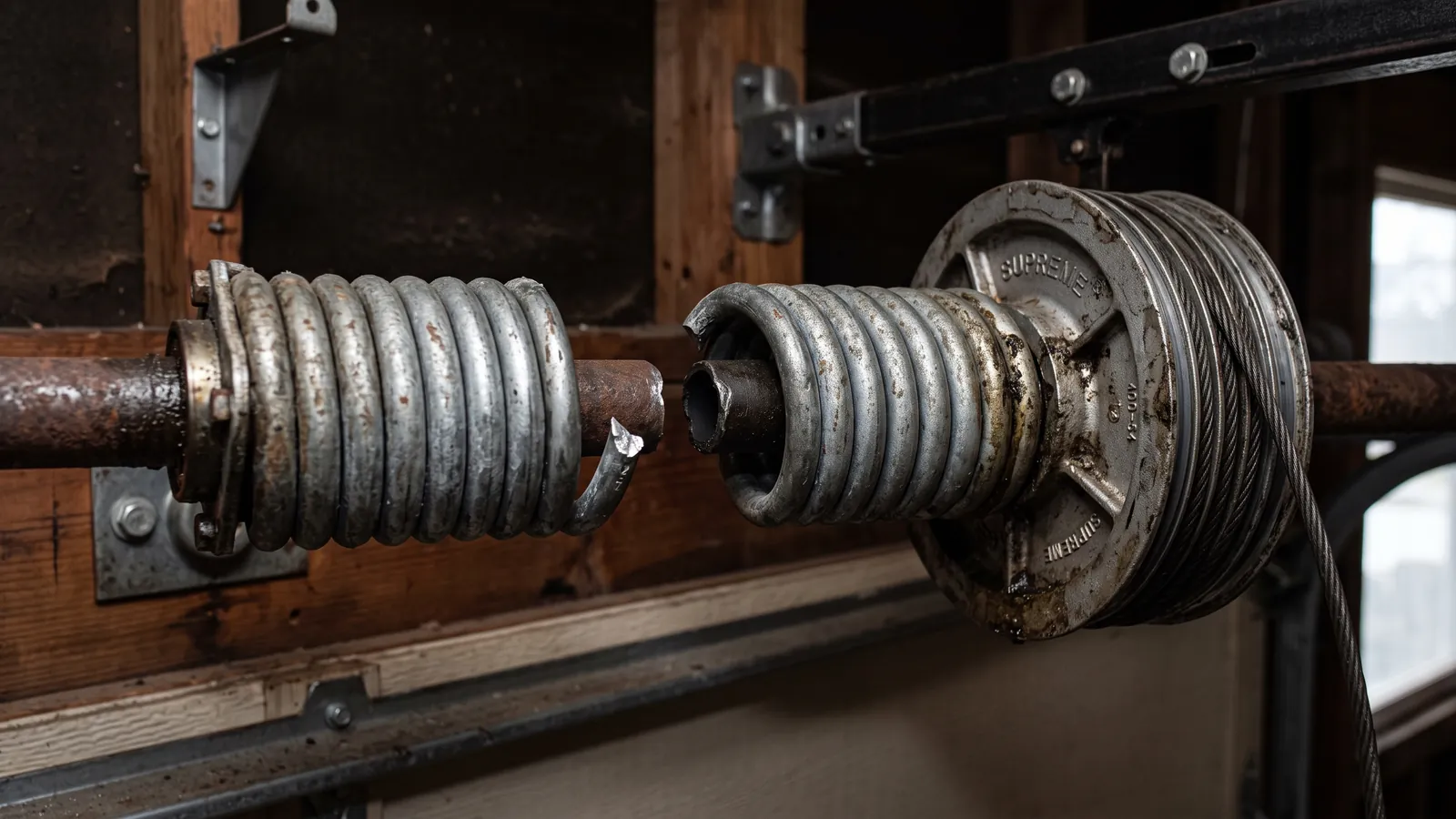
Rust bleeding along the coils. A door that has become noticeably heavier to lift by hand with the opener released. An opener that strains or groans where it used to run evenly. A gap, however small, anywhere in the coil. And simple arithmetic — if you know roughly when the springs went on and roughly how often the door runs, you can predict this one rather than discover it.
Common questions
How do I know if my door has one spring or two?
Look at the bar above the opening. One spring usually sits centrally above the door; two sit either side of a central bracket. Doors with springs running along the horizontal rails at the sides instead are extension-spring doors, common on older single-car openings in Kansas City and Prairie Village.
Is a high-cycle spring twice the price?
No, nowhere near — typically around $85 to $145 more for a pair, for roughly two and a half times the rated life. That is why it is the default recommendation on any door that is the household's main way in and out. On a door used twice a day it is less compelling.
Can I just buy the spring and have someone fit it?
We would rather supply it, because then the sizing is our responsibility and the warranty on part and labour sits in one place. If you have already bought one we will usually fit it, but we cannot warrant a component we did not supply, and if it is the wrong specification you have still paid for the visit.
Why did my springs only last three years?
Almost certainly cycles. A standard spring assumes four or five openings a day; a busy household does eight or ten and halves the life. The other possibility is that the springs fitted were slightly under-rated for the door, which makes them work harder than designed. Both are worth checking before you buy the same thing again.
Do springs cost more in winter?
No. The prices do not move with the season. What changes is demand — the first hard freeze produces a run of failures across the metro, so booking is tighter. That is an argument for having tired springs looked at in October rather than in January.
Related: Broken spring repair · Torsion spring replacement · Repair costs · Winter guide