Replacing springs on your terms, before one goes on the coldest morning of the year
There is a version of this job where you choose the time, the spring and the budget, and a version where the door decides for you at seven on a January morning. This page is about the first one.
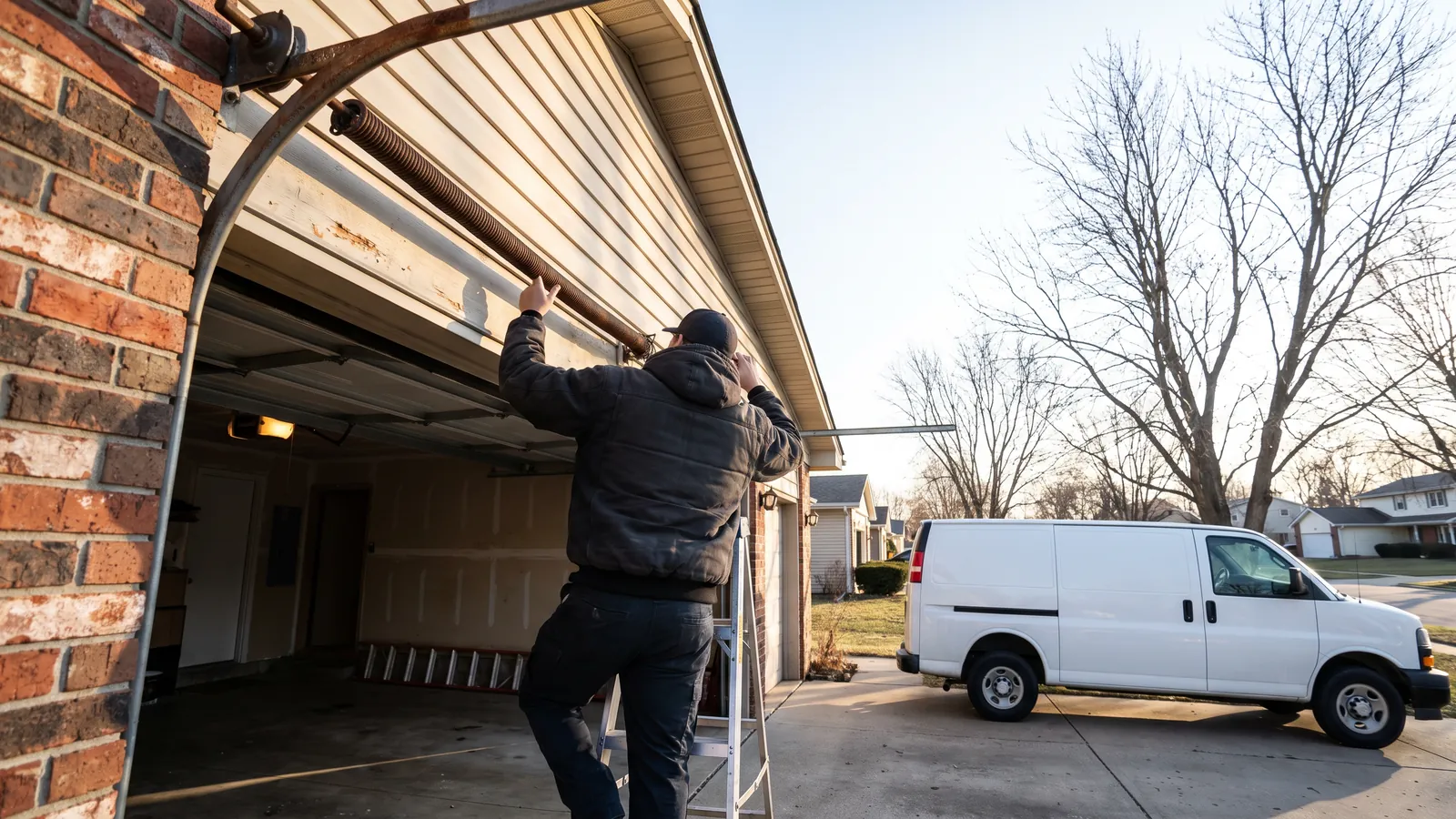
Springs are the one part of a garage door with a genuinely predictable life. They are rated in cycles, each open-and-close counts as one, and the arithmetic is straightforward: a standard 10,000-cycle spring on a door that runs four or five times a day has about six years in it. If the garage is how the household comes and goes — two cars, school runs, a teenager — ten cycles a day is realistic and the same spring is finished in under three years. Nothing about that changes because the door looks fine; a spring at the end of its count fails without warning.
So the sensible question is not "has it broken yet" but "how old is it and how hard does this house work it". If the door was new with the house and the house went up in the early nineties, as a great many Lenexa and Olathe houses did, the springs on it now are not the originals but they are probably not young either. If you have already had one replaced and the other is the survivor from that visit, its clock is well past halfway.
What you are choosing between. A standard pair is the cheapest way back to a working door and suits a garage used a couple of times a day. A high-cycle pair rated at 25,000 costs modestly more and lasts roughly twice as long, which makes it the better arithmetic on any door the family actually uses, and the obvious choice on an attached garage that functions as the front door. On older single-car openings in Kansas City and Leavenworth you may still have extension springs running along the side rails; those should always be fitted with containment cables so that a failure cannot throw the broken half across the garage, and if yours have none, that is worth correcting whether or not you replace the springs today.
Whichever you choose, sizing is the part that matters. Wire gauge, inside diameter and wound length have to suit the measured weight of the door, which is not always what a previous installer assumed. Fit a spring that is slightly under-rated and the opener spends its life compensating, which is how a perfectly good motor dies early. Every replacement we do ends with the door balanced by hand — it should stay put wherever you leave it — and the opener's force reset to match.
What's included
Life quoted in cycles, not vague years
You are told the rating of what is going on, and what that means for the number of times your household opens the door.
Standard or high-cycle, your call
The price difference and the life difference are both laid out, and nobody is pushed toward the dearer option.
Correct sizing every time
Gauge, inside diameter and length matched to the measured weight of the door rather than to whatever was on it before.
Containment cables on extension springs
Older side-rail springs get safety cables, so a failure cannot send half a spring across the garage.
Balance restored by hand
A properly sprung door holds its position anywhere in its travel; the technician checks it before touching the opener.
Opener force reset afterwards
A new spring changes what the motor has to do. Leaving the old force settings is how a good opener gets worn out early.
Spring replacement prices on the Kansas side
| Job | Typical price | Notes |
|---|---|---|
| Single torsion spring, standard | $215 – $340 | Fitted, wound and balanced |
| Matched pair, standard 10,000 | $310 – $495 | About six years on average household use |
| Matched pair, high-cycle 25,000 | $395 – $640 | Roughly double the life; best value on a busy door |
| Extension springs, pair | $180 – $330 | Containment safety cables included |
| Oversized or heavy wooden door | $420 – $780 | Carriage and solid-wood doors need heavier stock |
| Springs with cables and drums | $430 – $720 | Sensible when the shaft hardware is the same age |
| Second door, same visit | Less $45 – $90 | The call-out is already spent |
| Spring inspection, no work done | $0 | Included with any visit; you get the cycle maths free |
These are 2026 ranges for the Kansas side of the metro, to give you a figure to plan around. What you pay is agreed in the driveway before work starts, with parts and labour listed separately; new doors and openers get a written figure that holds for 30 days.
Recent work
Questions we get about spring replacement
How do I know when my springs are due?
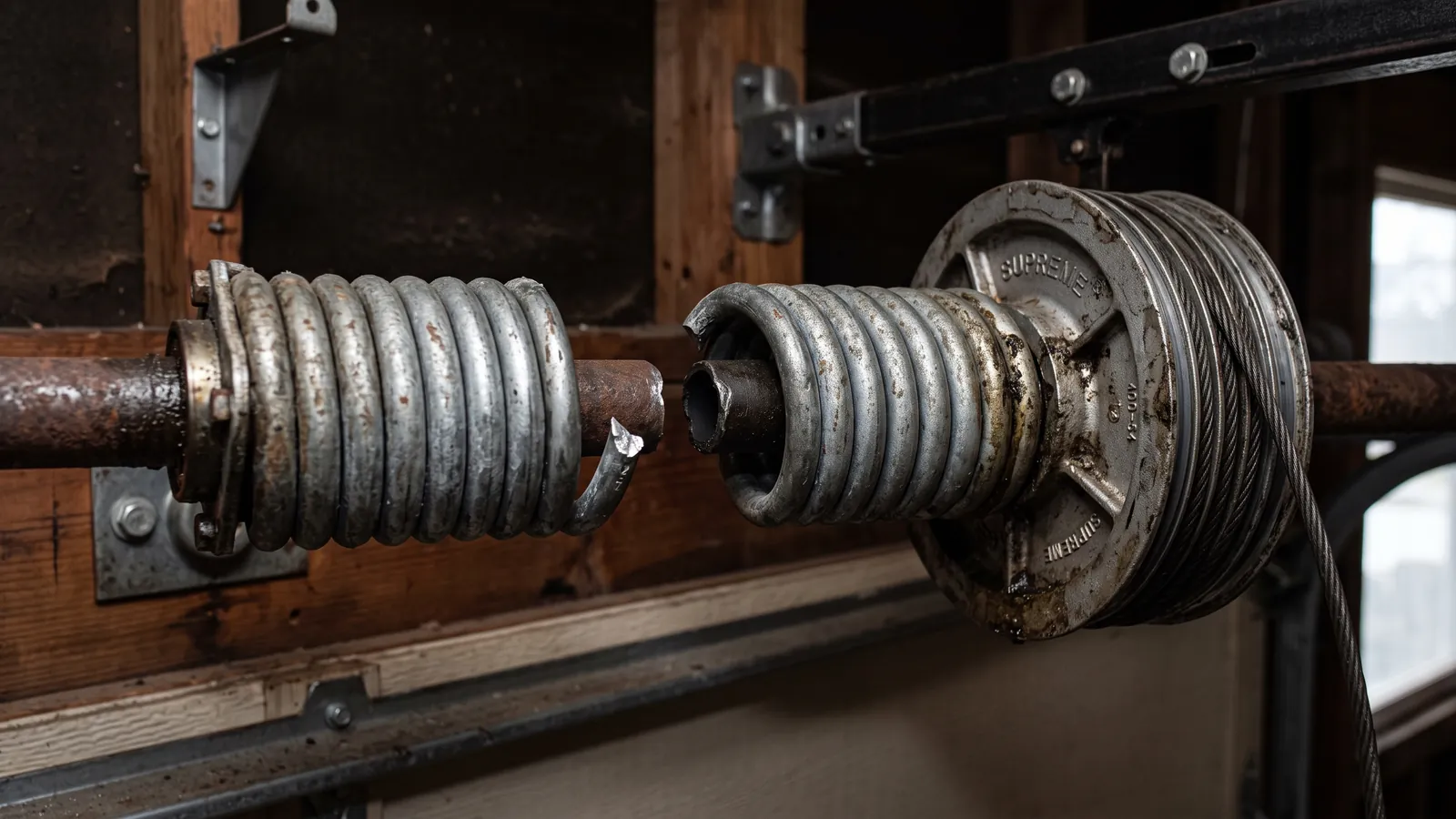
Count the cycles honestly. Open-and-close four or five times a day on a standard spring gives you six years or so; ten times a day roughly halves that. Beyond the arithmetic, look for gaps in the coil, rust bleeding along the windings, or a door that has started to feel heavier by hand or that the opener now audibly strains against.
Is high-cycle actually worth the extra?
On a door opened a couple of times a day, marginal. On a door the family uses as the main way in and out, clearly yes — the premium is modest and the life roughly doubles, so you are buying one visit instead of two. It also means fewer chances of the thing failing on a morning when you have somewhere to be.
Can you replace only the one that broke?
Yes, and we will if you ask. You should just know that the other has exactly the same cycles on it and typically follows within months, and that you will then pay a second call-out for a part that is a small share of the visit's cost. Most people, once they hear the numbers, do both.
My door has springs along the sides, not above. Is that a problem?
Not a problem, just an older design common on single-car openings around Kansas City and Leavenworth. Extension springs work perfectly well. What matters is whether they have containment cables threaded through them — without those, a break sends steel across the garage. If yours lack them, we fit them, and if headroom allows we can also talk about converting to torsion, which is quieter and safer.
Will new springs fix a noisy door?
They will fix the groaning and straining sound, because that is the opener fighting a door that is out of balance. A rumbling, clattering noise is usually the rollers instead — steel rollers get loud as they age, and swapping them for nylon while the technician is on site is inexpensive.
Do you have to replace the cables at the same time?
Not always. Cables are inspected as part of the job and replaced if they are frayed, kinked or corroded at the bottom brackets, which on a door of the same age they often are. If they are sound, they stay, and you do not pay for them.